Biochemical treatment solutions for high-salinity, recalcitrant organic wastewater
The WT-MSABP salt-tolerant biochemical treatment technology was jointly developed and applied in China by Shanghai Wending and Teijin of Japan. This technology uses high specific surface area fiber packing to screen salt-tolerant bacteria and adopts a multi-stage biochemical reaction zone design to form a unique microbial gradient population to meet the biochemical degradation treatment of recalcitrant organic pollutants.
Inquiry/Leave a Message
Technical features
High-performance fiber fillers
Specific surface area >4000m2/m3, sludge loading up to 12000mg/L, small footprint
Multi-partition reactor design
Establishing gradient microbial communities for rapid screening and cultivation of microbial strains.
Strong environmental adaptability
It can adapt to salinity environments of up to 2% and handle recalcitrant organic matter with a B/C ratio of 0.1.
Residual sludge reduction
Simultaneous nitrification and denitrification can reduce the amount of residual sludge by more than 60%.
Low operating costs
High degree of automation, precise chemical dosing, equipped with a precision dosing system, and the amount of pesticide used can be reduced by 30%.
Technological advantages
Small footprint
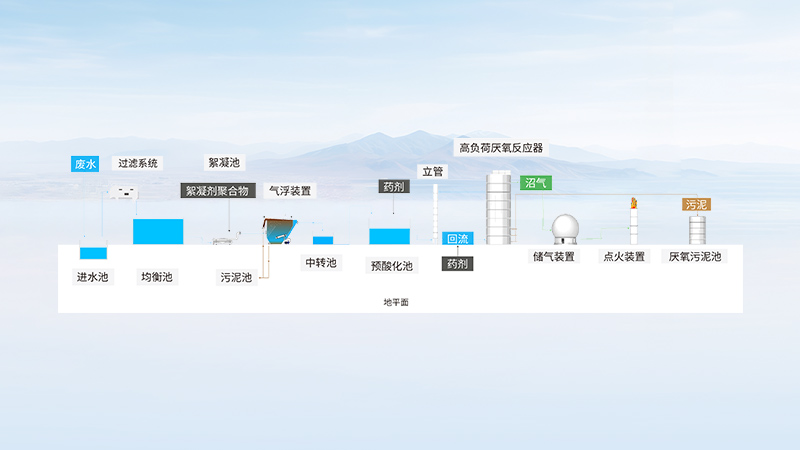
It occupies less space, requiring only 1/4 to 1/3 of the volume of a UASB, with a length-to-diameter ratio of 4-8.
High organic load
The volumetric loading rate of a high-efficiency anaerobic reactor is about four times that of a conventional UASB reactor.
Higher performance
More impact resistant and more stable performance
Simpler
The operation and management are simpler, making it more convenient for customers' daily management.
Application areas
Wastewater treatment in the food and beverage industry
Biochemical treatment of recalcitrant wastewater from fine chemical industry
High-difficulty organic wastewater treatment in pharmaceutical and pesticide industries
Biochemical treatment of high-salt wastewater from textile printing and dyeing